
AI Search, SEO, and GEO: What Should Actually Change?
AI search and GEO are changing how people talk about content, but the basic work is still clear: make useful pages that can be crawled, understood, cited, and trusted.
AI Search, SEO, and GEO: What Should Actually Change?
Many site owners now ask the same question: if search results include AI-generated answers, will ordinary blog posts still matter?
The useful answer is less dramatic than the headline version. According to Google Search Central, the core SEO practices are still relevant for AI features in Google Search. There are no separate special requirements for appearing in AI Overviews or AI Mode. That does not mean nothing changes. It means the work shifts toward clearer, more useful, more verifiable pages.
GEO, or Generative Engine Optimization, is a helpful label only if it keeps us focused on useful content. It becomes misleading when it turns into a promise that a page can force its way into AI answers.
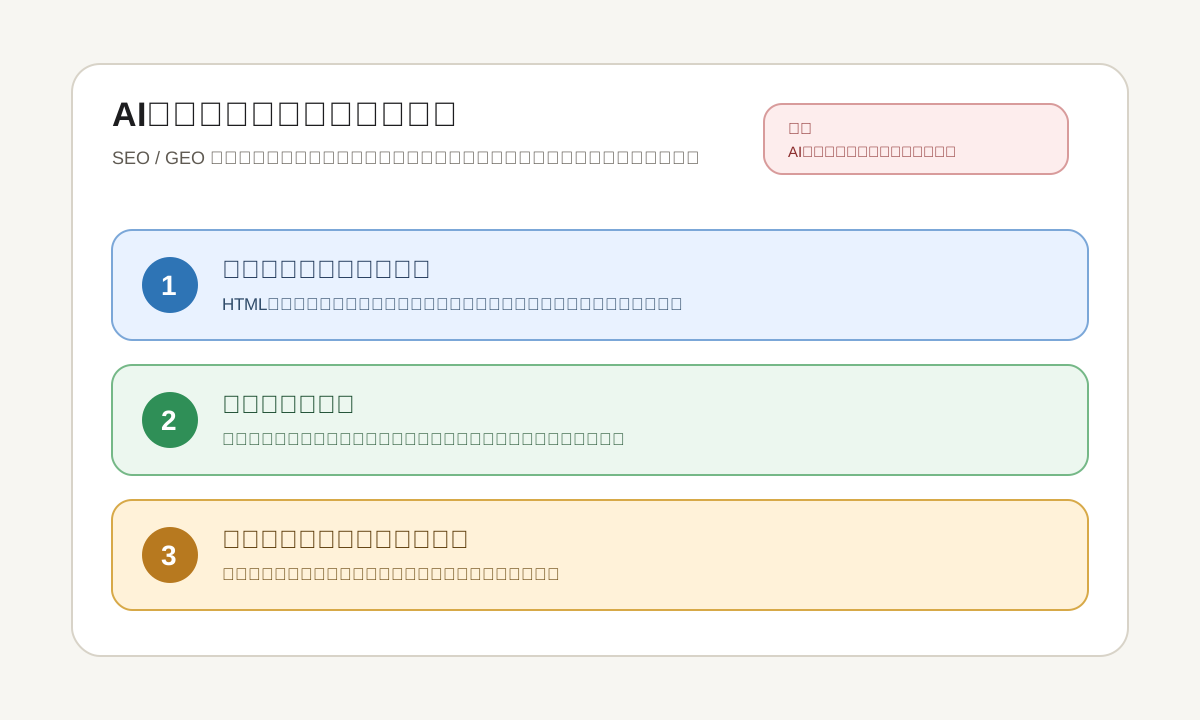
What to review in August 2026
The summer 2026 updates point in one practical direction: AI search work is becoming less about tricks and more about measurable editorial quality.
In June 2026, Google Search Central announced dedicated Search Console performance reports for generative AI features. The rollout is limited at first, but the direction matters: site owners are getting a clearer way to review visibility from features such as AI Overviews and AI Mode instead of treating all search exposure as one undifferentiated number.
Google has also been explaining how AI Search can surface original content, favorite sources, and high-quality references. For a publisher or small product site, the lesson is not to write more "AI-optimized" wording. The lesson is to make it obvious what each page answers, which claims are sourced, and why the page is useful as a reference.
For WizPulseAI, that turns into a weekly operating habit:
- Check whether key articles have a current answer, current date, and current sources.
- Keep important explanations in crawlable text, not only inside diagrams.
- When Search Console exposes generative AI reporting for the property, track which pages receive impressions and whether users still click through.
Even if the new report is not available for a site yet, the preparation is useful. Every important article should state the reader question, the direct answer, the evidence, and the next related article.
What does not change
Pages still need to be crawlable, indexable, and useful. Important text should be available as text, not locked inside images. Titles and headings should describe the page honestly. Claims about dates, tools, products, prices, laws, or numbers need sources.
These basics may sound old-fashioned. They are also the part many weak pages skip.
AI search makes that weakness more visible. If a page has vague headings, no clear answer, no sources, and exaggerated language, it is harder for both people and systems to use it as a reliable reference.
What does change
The shape of the answer matters more.
Traditional SEO often focused on getting a searcher to click into a page. That still matters. But AI search can also use a page as one source among several when building an answer. A useful page therefore needs clear sections that answer real questions.
A weak opening says:
The complete guide to AI search optimization in 2026.
A stronger opening says:
AI search does not replace SEO. It rewards pages that answer clearly,
show their sources, and avoid unsupported promises.
The second version gives readers a position they can evaluate.
Do not turn GEO into a trick
Avoid these habits:
- Repeating the same definition unnaturally.
- Publishing thin FAQ pages just to target more query variants.
- Promising AI Overview visibility.
- Calling an article "latest" without checking sources.
- Writing for a crawler while forgetting the reader.
Google's generative AI search guidance points back to helpful, reliable, people-first content. From that perspective, SEO, AEO, and GEO are not separate magic systems. They are different ways to describe the same editorial discipline: make pages that people can understand and trust.
A practical five-part brief
Before writing or refreshing an article, decide five things.
| Question | Why it matters |
|---|---|
| What is the reader asking? | Prevents vague keyword pages. |
| What is the direct answer? | Helps readers and search systems understand the page quickly. |
| Which claims need sources? | Keeps current facts separate from editorial judgment. |
| What may become outdated? | Flags dates, product names, UI details, policies, and numbers for rechecking. |
| What should the reader read next? | Builds a useful internal path instead of a dead end. |
This is the same method WizPulseAI uses for Knowledge Hub. We do not publish an article because a keyword exists. We publish when the page answers a real question and can be maintained.
A quick refresh checklist
Use this for older articles:
- Does the title match a real reader question?
- Does the introduction give a clear answer?
- Can the headings be understood without reading every paragraph?
- Are dates, numbers, product names, and policy claims sourced?
- Are strong words such as "best", "complete", or "must-have" justified?
- Is important information available in crawlable text?
- Are there one to three useful internal links?
The goal is not to produce more pages. The goal is to make each page more useful.
How WizPulseAI will use this
For Knowledge Hub, this means:
- Refresh useful old articles before creating duplicate pages.
- Add sources to current or market-related claims.
- Keep product, pricing, privacy, credits, refunds, and account claims behind review.
- Use visuals only when they explain something.
- Avoid promising AI search visibility.
- Keep beginner articles short enough to read and clear enough to cite.
This is slower than publishing large batches of generic content. It is also more durable.
Official sources
- Google Search Central: AI features and your website
- Google Search Central: Optimizing your website for generative AI features on Google Search
- Google Search Central: Creating helpful, reliable, people-first content
- Google Search Central Blog: Search Generative AI performance reports in Search Console
- Google Search: New ways to find favorite sources and original content