
AI Output Verification Checklist for Everyday Work
A practical checklist for checking AI-generated text, summaries, plans, research notes, and recommendations before using them in real work.
AI Output Verification Checklist for Everyday Work
AI can produce polished output quickly. Headings look organized. The tone sounds confident. The answer may even feel ready to paste into an email, article, report, or team document.
That is useful, but it creates a simple risk: a wrong answer can look finished.
Before using AI output in real work, treat it as a draft. Run a short check for facts, sources, context, assumptions, private information, and public-risk wording.
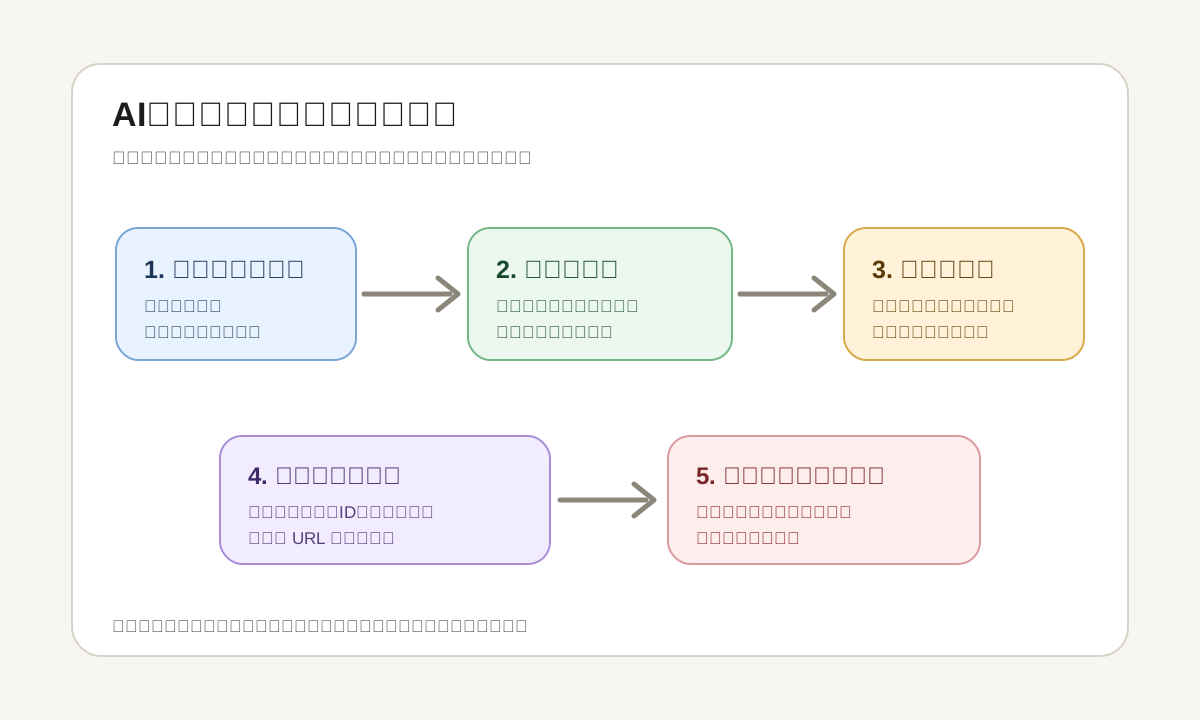
2026 update: review points matter even more with agentic tools
AI tools are no longer limited to answering a single question. In 2026, more products are being positioned around multi-step work: gathering material, creating documents, working across files, and staying with a task for longer periods.
That does not remove the need for review. It makes the review point more important.
Before an AI system acts on a workflow, decide:
- What information it may use.
- What it must not access or upload.
- Which steps need human approval before anything is sent, published, deleted, or changed.
- Where the final output will be checked and stored.
For everyday teams, the practical rule is still simple: let AI help with drafts and structure, but keep human approval around facts, commitments, private data, and external actions.
First, classify the risk
Not every AI output needs the same level of review. Start by deciding how risky the output is.
| Risk level | Examples | How to handle it |
|---|---|---|
| Low | Personal notes, brainstorming, rewriting a sentence | Read once and use carefully |
| Medium | Internal summaries, meeting notes, research drafts, FAQ drafts | Check facts, context, missing information, and privacy |
| High | Customer-facing text, prices, contracts, legal, medical, financial, security, public articles | Require responsible human review and source checks |
When unsure, move the output up one risk level. Anything that reaches customers, changes user expectations, or looks like a company promise should not be approved by AI alone.
The 10-minute review
You do not need a complex review process for every draft. This short sequence catches many common mistakes.
1. Check facts first
Look for claims that can be wrong:
- numbers
- dates
- names
- prices
- laws or rules
- product features
- quotations
If a claim matters, verify it with a reliable source. Do not rely on tone or confidence. AI may write an outdated policy, a non-existent quote, or a feature that sounds plausible but is not real.
2. Check the source
If AI gives a link or document name, open it.
| Check | What to look for |
|---|---|
| Does the link exist? | Avoid 404s, redirected pages, or unrelated URLs |
| Does the source support the claim? | The source should actually say what the draft says |
| Is the date still useful? | Prices, product specs, laws, and model abilities age quickly |
| Is the quote accurate? | Do not turn a loose paraphrase into a quotation |
If you cannot find the source, delete the claim or mark it as unverified. A clean missing-source sentence is worse than no sentence.
3. Check the context
Ask whether the output fits your actual situation:
- Is the audience correct?
- Is the market or region correct?
- Is the product stage correct?
- Does it assume a feature that does not exist?
- Does it mention a policy that is not final?
- Does it turn an internal plan into a public promise?
AI often gives a generally reasonable answer that is still wrong for your exact context.
4. Separate facts from assumptions
When the output includes strategy, planning, or recommendations, mark each part:
| Type | Example |
|---|---|
| Confirmed fact | A feature described on an official page |
| Reasonable assumption | A likely outcome based on past behavior |
| Open question | Something the team still needs to check |
| Editorial judgment | A point of view or recommendation |
This makes the output safer to share with other people.
5. Check privacy and safety
Before saving or sharing the result, confirm that it does not include private data, internal secrets, or customer-specific details.
- names, email addresses, phone numbers
- customer names, account IDs, order IDs
- private URLs or internal document names
- unreleased plans, budgets, contract terms
- API keys, tokens, passwords, credentials
- user-specific behavior or support history
If the detail is not necessary, remove it. If the work requires sensitive information, use only approved tools and rules.
6. Check the strength of the wording
AI text can sound too certain, too formal, or too promotional. For external work, check:
- Is the promise realistic?
- Does it sound natural?
- Is the CTA too aggressive?
- Does it hide a limitation?
- Does it use words the brand would not use?
- Does it say "always", "guaranteed", "best", or "fully secure" without evidence?
Safer writing is usually more specific:
| Too strong | Safer |
|---|---|
| This will eliminate mistakes | This can reduce common mistakes |
| Anyone can do it easily | This is a small place to start |
| This is the best method | This is a practical first method |
| It is completely safe | It lowers risk when used with review |
Use AI as a first reviewer
AI can help review its own draft, but do not treat that review as final. Use it to find issues faster.
Try this:
Review the output below.

Goal:
I want to find factual and risk-sensitive issues before using this in work.

List:
1. factual claims that need verification
2. source links or citations that need checking
3. hidden assumptions
4. private or sensitive information
5. wording that sounds too certain
6. sentences a reader may misunderstand

Do not rewrite the whole text yet.
Return a table with the issue, why it matters, and suggested action.
This turns AI into a reviewer, not just a writer.
Extra checks for public articles
For Knowledge Hub-style content, verification is also part of SEO and GEO work. Google’s public guidance for generative AI features still points site owners toward useful, reliable, people-first content rather than thin AI-written pages.
Before publishing, check:
- Does the title match the actual article?
- Are current claims supported by public sources?
- Are dates and product names fresh?
- Can the reader act after reading?
- Are internal links useful?
- Is the article more than a generic summary?
- Are product, legal, privacy, pricing, account, or payment claims approved?
The goal is not to create more words for search. The goal is to publish a page that remains useful when a reader or AI search system needs a clear, citable answer.
Summary
AI output should be treated as a draft. First classify risk. Then check facts, sources, context, assumptions, privacy, and wording strength before using it.
The more public or consequential the output is, the more deliberate the review should be. Good AI work is not just fast writing. It is fast drafting with clear human judgment at the right point.
Next, read Prompt Engineering Basics, AI Data Safety Basics, and AI Workflow Guide to turn this checklist into a repeatable routine.
Sources
- OpenAI Help Center: Does ChatGPT tell the truth?
- Google Search Central: Creating helpful, reliable, people-first content
- Google Search Central: Optimizing your website for generative AI features in Google Search
- NIST AI Risk Management Framework
- OpenAI: ChatGPT is now a partner for your most ambitious work