
10 Dinosaur Questions for Kids
A dinosaur quiz does not have to reward the person who memorized the most names. It becomes more interesting when a family looks at bones, teeth, footprints, and eggs and asks, "What could this clue tell us?"
The ten questions below use information published by natural history museums. Make a guess first, then read the answer and the evidence together. Some explanations can change as new fossils are studied, so "this is what the evidence currently suggests" is a useful answer too.
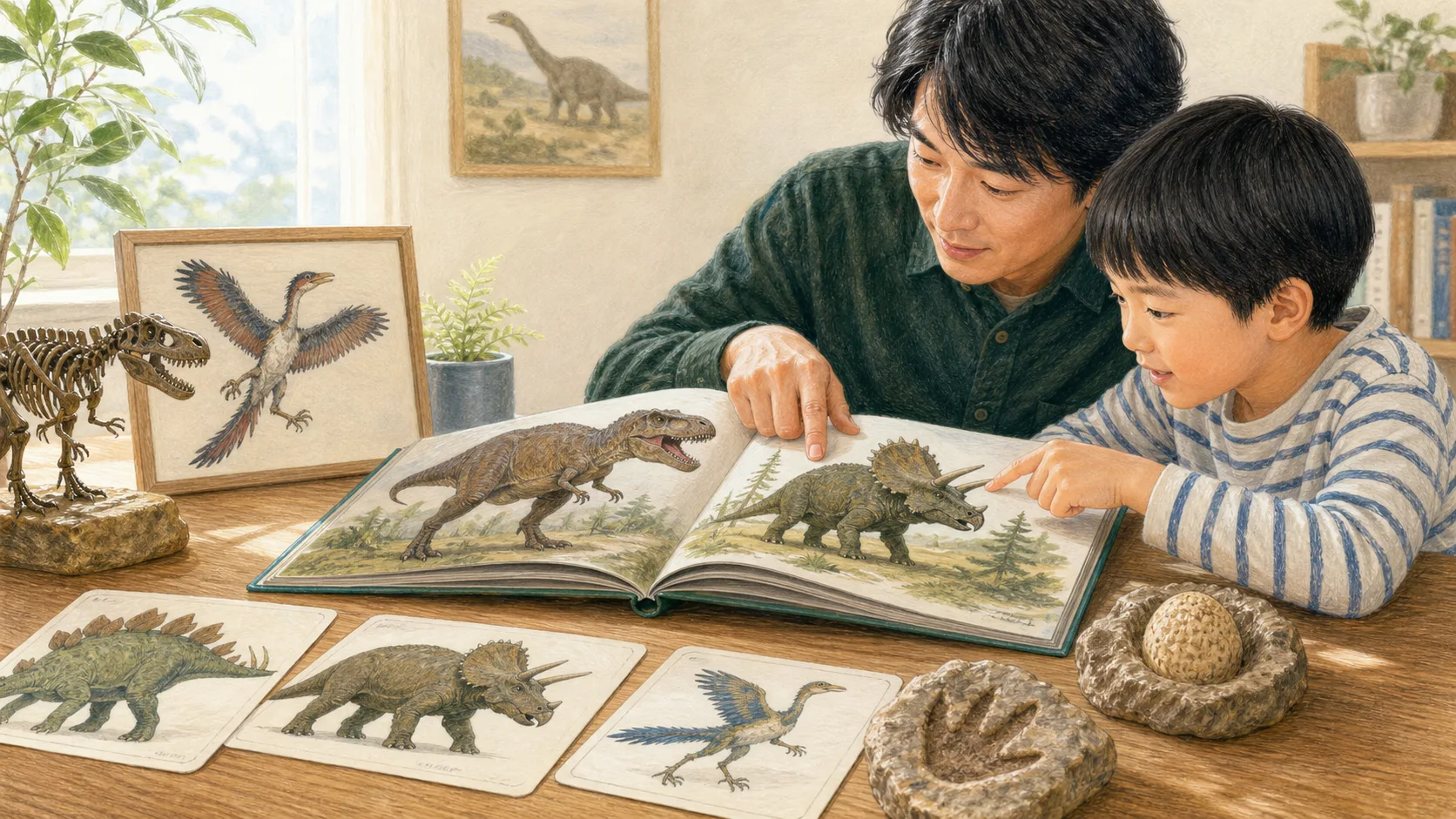
1. Which lived first: Stegosaurus or Tyrannosaurus rex?
Answer: Stegosaurus.
Stegosaurus lived in the Late Jurassic, around 150 million years ago. Tyrannosaurus lived much later, in the Late Cretaceous. They often appear together in toys and films, but their lives were separated by tens of millions of years.
Try placing two cards on a long paper timeline. Asking "Which card goes farther to the left?" makes geological time easier to picture.
2. Were all dinosaurs enormous?
Answer: No. Some were small.
Dinosaurs included giant sauropods, but some species were around the size of a chicken. Museum halls and movies naturally emphasize the biggest skeletons, which can make the whole group seem gigantic.
Instead of memorizing a length, compare it with a person, a room, or a bus. "Would it fit under this table?" is often a better conversation starter than a number alone.
3. Were flying pterosaurs dinosaurs?
Answer: No.
Pterosaurs were reptiles that lived alongside dinosaurs, but they belonged to a different group. Marine reptiles such as plesiosaurs were not dinosaurs either. Not every large prehistoric reptile was a dinosaur.
When you open a dinosaur book, look beyond the animal's name and find its group. Similar-looking animals can have important differences in their hips and limbs.
4. Are any dinosaurs alive today?
Answer: Birds are living dinosaurs.
Modern birds are part of the dinosaur family tree. Non-avian dinosaurs disappeared during the mass extinction about 66 million years ago, while the lineage leading to birds survived.
The next time you see a bird, look at its toes, movement, feathers, and beak. This question brings dinosaurs out of the distant past and into an ordinary walk outside.
5. Are dinosaur fossils always bones?
Answer: No.
Teeth, eggs, nests, footprints, skin impressions, and fossilized dung can all preserve evidence about ancient life. A fossil may record an animal's body or something it did.
Ask what each clue might reveal. Teeth can help researchers investigate diet. Tracks can reveal movement. Eggs and nests can provide evidence about reproduction and behavior.
6. Can footprints show how fast a dinosaur moved?
Answer: A trackway can help researchers estimate it.
One print cannot answer every question. A sequence of prints can preserve stride length and direction, giving researchers evidence about movement and possible speed.
Draw one row of footprints close together and another farther apart. Ask which animal seems to be moving faster, then discuss what other measurements a scientist would need.
7. How do scientists investigate what a dinosaur ate?
Answer: They study teeth, jaws, fossilized dung, and other evidence.
Pointed, curved, serrated teeth handled food differently from broad teeth used to crop or grind plants. A tooth is an important clue, but it does not tell the whole story by itself. Researchers compare several kinds of evidence.
Cover the rest of a dinosaur picture and look only at its mouth. Make a prediction, then name the clue that led to it.
8. Did all dinosaurs live at the same time?
Answer: No. The age of dinosaurs was very long.
Dinosaurs diversified across the Triassic, Jurassic, and Cretaceous periods. Different animals lived in different places and at different times.
Choose two favorites and compare both when and where they lived. A dinosaur directory then becomes a map of time and place, not just a gallery of names.
9. Did only an asteroid cause the non-avian dinosaur extinction?
Answer: A large asteroid impact is the leading explanation for the end-Cretaceous mass extinction, while other environmental factors are also studied.
The impact near what is now Mexico and the environmental changes that followed are central to the scientific explanation. Researchers also investigate the effects of volcanic activity, changing sea levels, and climate shifts around the same period.
This is a useful place to show that science does not force every event into a one-sentence answer. Better evidence can make an explanation more detailed.
10. Has a new dinosaur been named from fossils found in Japan?
Answer: Yes. Fukuiraptor is one example.
Fukuiraptor kitadaniensis was named in 2000 from fossils discovered in Katsuyama, Fukui. The Fukui Prefectural Dinosaur Museum describes it as the first dinosaur reported as a new species from Japan.
Famous dinosaurs are not only found overseas. Looking up the geology or museum collections in your own region can make paleontology feel much closer to home.
Three ways to keep the quiz playful
- Ask for a guess first. Start with "What do you think?" rather than the correct answer.
- Name one clue. Bone, tooth, track, place, or time is enough for one round.
- Leave room for uncertainty. Do not turn an open research question into a neat fact just to finish the quiz.
For another short activity, try Dinosaur Discovery at Home. When a family uses an app or website together, the Family Rules for Safer AI and Learning Apps offers a simple starting point.
Pick one dinosaur in Dino Kids
Dino Kids gives families a place to choose a dinosaur and compare names and features. You do not need to use all ten questions at once. Open the encyclopedia with one theme, such as feet today and teeth next time, and let the conversation stay short.
Sources
- Fukui Prefectural Dinosaur Museum: Dino Dictionary
- Fukui Prefectural Dinosaur Museum: Fukuiraptor kitadaniensis
- American Museum of Natural History: Dinosaur Facts
- American Museum of Natural History: Types of Dinosaurs
- American Museum of Natural History: What Do You Know about Paleontology?
- Natural History Museum: What are dinosaurs?
- Natural History Museum: When did dinosaurs live?
- Smithsonian National Museum of Natural History: Explore How Dinosaurs Moved
- Smithsonian National Museum of Natural History: Extinction Over Time